.png)
Hard Doesn't Mean Not Worth It: On Reading Classical Black Literature
For the average person, or even the average reader, picking up a book by James Baldwin, Toni Morrison, Ralph Ellison, or Zora Neale Hurston today may prove to be an uphill battle of understanding. You'll probably need to reread paragraphs—or entire chapters—multiple times just to grasp what's being said. Sometimes it's the underlying meaning. Sometimes it's the words themselves. Either way, the first read is rarely enough. I hope I'm not alone in this.
For this year and for Black History Month, I wanted to challenge myself to step outside of my comfort zone and pick up books by some of the aforementioned authors. Fiction is my first love, but after being in a nearly six-month slump, I wanted to exercise another part of my brain, scratch an area I probably hadn't had to itch since undergrad. And, I'll be honest. I've avoided classical Black literature because I knew those authors would probably talk circles around me. And I was right.
In this quest of intentional reading, I picked up The Fire Next Time by James Baldwin. My first book by him, actually. I didn't know where to start, so I picked at random.
Going into the book, I was really excited to finally be able to enter James Baldwin's world and form my own personal opinion on why he goes down as a classic Black author to read. I expected to have some highly intellectual space within my brain unlocked, to awaken my own personal thoughts relating to race exploration and the Black experience. Funny thing about expectations, though. They're not always met. Now this isn't blame on James Baldwin in any sense, but on my own intellectual ability to keep up when reading. I half expected for him to talk circles around my level of comprehension, but I didn't expect for him to have me stumped for the first half of the book.
I reread the first thirty or forty pages so many times trying to understand what was going on. Early in the book, Baldwin was discussing living in Harlem, the surrounding environment, his time in church—and I genuinely didn't know where the story was going. Coming from the romance and mystery space, you generally have an idea of the plot as outlined by the synopsis, and in a way, I don't have to do much thinking. I just follow the story as it's laid out. There's an element of escapism and freedom—you get to just ingest the details laid out by the author. However, The Fire Next Time took me back to college English. I don't think I've really had to read in such a comprehensive manner in years. And for a skill like that, if you don't use it, it's hard to really tap into it (at least for me).
So that begs the question: why is classical literature hard to follow and comprehend for some people?
Part of it is the prose itself. The way Baldwin writes, the way many of these authors write, is different from what most of us read today. Sentences are longer and the rhythm is quite different. The references assume cultural and historical knowledge that we may or may not have (I'm certain I didn't). A lot of us weren't taught how to read this kind of writing, so we're essentially teaching ourselves as adults. And that's extremely hard.
With genre fiction, you can escape into the narrative without knowing every reference. With Baldwin and nonfiction from that era, though? You need that context to make sense of not just the story, but the impact. Without it, you're working twice as hard. Now, I want to be clear—this might not be everyone's experience. People from older generations who grew up with these authors as required reading, who had teachers breaking down Baldwin's essays line by line, might not find this as difficult. I don't know what the curriculum looked like back then. But for a lot of us later millennials and early Gen Z readers, classical Black literature wasn't always centered in our education. Some of us got excerpts. Some of us got one book if we were lucky (I only recall reading Toni Morrison's Beloved). And some of us got nothing at all. So when we pick up these books now as adults, we're not just reading—we're catching up on an education we didn't get.
But here's the thing: hard doesn't mean not worth it. I really just had to keep reading and push through. When Baldwin met with Elijah Muhammad and beyond, things started to click. Ideas started to come together for me. It wasn't immediate, and it wasn't easy, but it happened. And that's what made it worth it.
Why These Books Still Matter

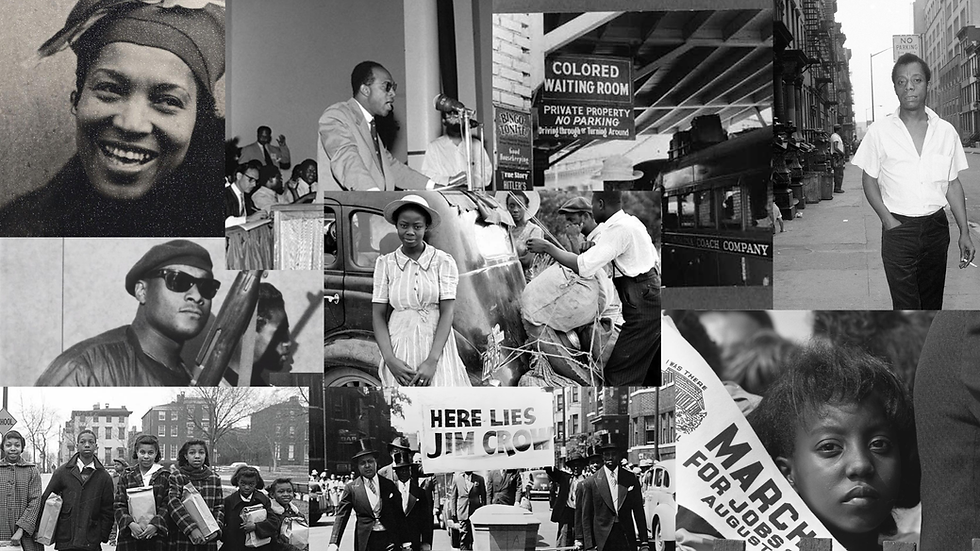
These books—The Fire Next Time, Beloved, Invisible Man, Their Eyes Were Watching God—aren't just critically acclaimed because they're well-written. They're essential because they document, explore, and articulate the Black experience in ways that were (and still are) revolutionary.
When Baldwin published The Fire Next Time in 1963, he was writing directly into the heart of the Civil Rights Movement. He was naming things that needed to be named. He was challenging both white America and Black America to reckon with themselves. What he was doing wasn't just writing. These books changed conversations.
They forced reckonings. That's why we keep passing these stories down. That's why these books still matter. Not because they're "classics" in some dusty, academic sense, but because they're still doing the work. They're still teaching us. They're still challenging us to think harder, see clearer, understand deeper.
Building Your Own Reading Curriculum
I came across the idea of building a personal reading curriculum from TikTok, and I thought it would be a neat project—as an avid reader, a lifelong learner, and someone on a quest to become disgustingly educated.
A reading curriculum doesn't have to be formal like back in school. It's just intentional. Pick a theme—Civil Rights History, Black Feminism, the Harlem Renaissance, whatever you're curious about—and build a list of books that explore it (I might do you a solid and create some sample curriculums for you in the near future). Read them in sequence. Take notes. See how each one builds on the last. Let yourself struggle with them. Let yourself sit with ideas that don't come easy.
Classical Black literature is a good place to start because these books aren't just telling stories—they're shaping how we understand ourselves, our history, and our present. They're hard because they demand more of us. And that's exactly why they're worth reading. You'll also be surprised by the parallels between then and now.
Start with one. Just one. Pick up Baldwin. Pick up Morrison. Pick up Hurston. Give yourself permission to reread the same page five times. Give yourself permission to not understand everything on the first pass. That's part of the process.
And if you want help building that curriculum—or organizing your reading life in general—I've created something that might help. A complete reading system that helps you track not just what you read, but how you engage with it. Make sure you're subscribed to be the first to know when we share it.
As we wrap up the last few days of Black History Month, I hope you'll continue to delve deep into our history—not just in February, but all year. Pick up a classic you've been avoiding. Start your own reading curriculum. Give yourself permission to struggle with a book. Reread the same page five times or ten times if you need to.
I personally think it's important that we preserve these voices. Whether fiction or factual, they're all history. And at a time where history is being erased in schools and in the world, we have to hold onto what was once true. These books are history lessons in themselves, still demanding that we pay attention.
I'll be over here, still working my way through Baldwin's catalog. Reply or comment and let me know what you’ll be reading.
Until the next thought,
Happy Reading

Comments